
Concepts
AI-first vs AI-native: what's the difference and what it means for your company
Everyone says “AI-first” and “AI-native” as if they were the same thing. They aren't. One is a decision about priority; the other is a way for the company to work. Mixing them up is the cheapest way to spend a year “doing AI” while the company still depends on you for everything. This article separates the two ideas, shows where each one fails and proposes a realistic path for companies that already run, which is most of them.

By Cesar Augusto Carlos
In this article
First: there is no official definition
Neither term has a standard definition. Whoever claims one is usually selling something. What exists are recurring uses, and they help show the difference.
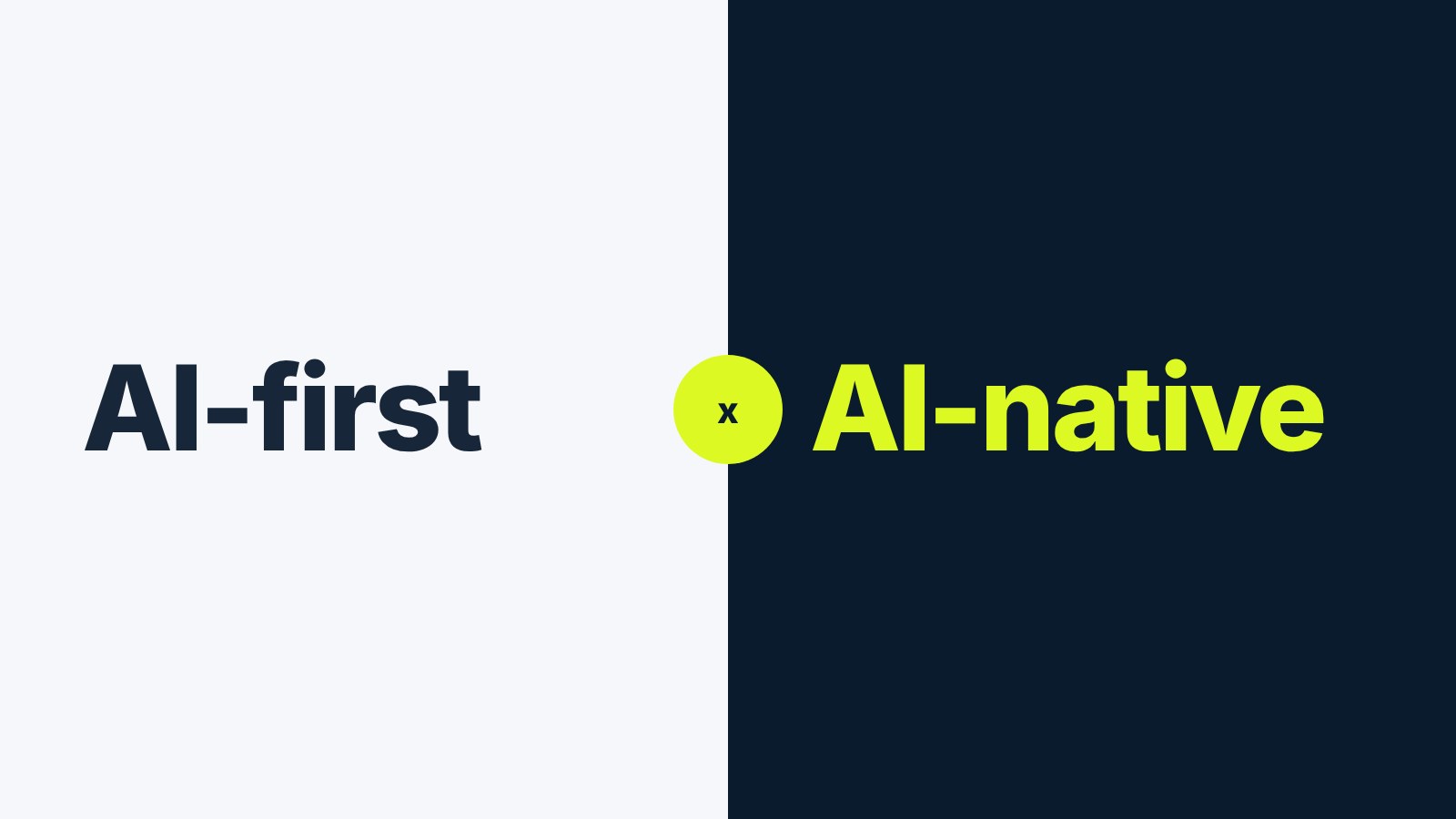
AI-first usually describes a stance: AI comes first when deciding how work gets done. The clearest example is the April 7, 2025 memo from Tobi Lütke, Shopify's founder and CEO. In practice: before asking for more people or resources, teams must show why they can't do the work with AI. Note what that is: an order of priority. It doesn't say how the work is built inside.
AI-native usually describes a build: the company was designed (or redesigned) around AI. Bain & Company describes the AI-native enterprise as one that moved beyond fragmented tool deployment and uses AI to redefine the operation itself, instead of just speeding up what it already did. For Bain the core is “proprietary intelligence”, supported by proprietary data, codified workflows and a learning architecture in which each new use builds on the last.
A simple test, attributed to a participant in an expert panel: if you are AI-native, your company doesn't make sense without AI. Remove the AI and the business stops. In an AI-first company, remove the AI and the business slows down but still stands.
AI-first
- A priority: AI comes first in the decision
- Lives in the rule, the message and the culture
- Without AI, the company slows down
- Held up by: people using tools
- Typical risk: becoming a slogan and pressure on the team
AI-native
- A build: the work was assembled around AI
- Lives in the data, the workflows and the agents
- Without AI, operations stop
- Held up by: a system that accumulates knowledge
- Typical risk: a project so big it never goes live
Two ways to get it wrong
1. AI-first with no system underneath
When the priority is decreed but there is nowhere for AI to work, the company turns into a pile of loose tools: one person writes proposals in ChatGPT, another summarizes meetings, someone built an automation on WhatsApp. Each one saves time. The company gains no clarity.
The best-known case is Duolingo. In late April 2025, CEO Luis von Ahn posted a memo on LinkedIn saying the company would be “AI-first”. According to Fortune, the text said the company would gradually stop using contractors for work AI could do and would only hire if teams couldn't automate further. The reaction was strong. In August he admitted the memo lacked context. The lesson isn't about AI: it's about announcing a priority without showing what changes for people and where the AI will work.
2. AI-native in name only
The opposite: the company calls itself “native” because it bought several AI tools. If AI sits on top of what already existed, with the same processes, the same knowledge in people's heads and the same scattered data, what you have is an AI-enabled company. It works and it helps, but it doesn't change the operation.
The practical test: what happens when the person who “knows how it works” goes on vacation? If the answer is “everything stops”, AI isn't built into the company. It's leaning against it.
What an operation built around AI looks like
A Brazilian example, with the caveat that these are the company's own statements. At the Bloomberg Línea Summit in October 2025, iFood CEO Diego Barreto said that 90% of support interactions run through three AI agents: one for consumers, one for restaurants and a third that coordinates the others, like a conductor. What matters here isn't the number, it's the design: agents with defined roles and a coordinator, working on the operation's own data. That is a build, not a slogan.
Honest question for the reader: do you need to be iFood to have something similar at a smaller scale? No. But you need data in one place, written workflows and someone (an agent or a person) with a clear role. We explain this design in AI agent orchestration.
Find out how much of your company still depends on you.Take the free index
What if you already run a company?
Almost everyone does. And here the conversation gets more sensible than the debate over labels. In the debate on this topic, two positions show up. One says a company is only AI-native if it was built that way from the start. The other says the opposite: nobody becomes “native from day one” after the fact, but established companies can build native parts, and those parts can grow. I side with the second reading, for a practical reason: the owner of a 15-year-old company isn't going to start over. But they can start with one part.
- 01Map where the knowledge lives
Not the org-chart processes: what really makes the company run. Who knows the discount you can give, who knows the difficult client, where the history of that contract is. A lot of it sits in WhatsApp, spreadsheets and people's heads.
- 02Codify the workflows that repeat
What comes in, who decides, what goes out. Writing it down stops being bureaucracy: it is what lets an AI agent work with you, not next to you.
- 03Make the data accumulate
Every service request, proposal and decision should leave the company a little smarter instead of vanishing in a chat. It's Bain's idea of proprietary intelligence, at small and mid-size company scale.
- 04Put agents to work
Simple, repeated tasks first, with human approval where it matters. The owner keeps deciding. The agent prepares, summarizes, chases and alerts.
That is, in essence, what NoOne calls Business AIOS: a system that brings the company's data, workflows and agents into one place, so the owner sees everything and decides what matters. It isn't a promise of “without you”. It's the opposite: you in control of everything, without having to do everything.
If most answers are “no”, the company is probably AI-enabled: it uses AI but isn't built with it yet. That's fine: it is the most common starting point. The problem is thinking you are further along.
What nobody says about this debate
First: the label matters less than it seems. You don't need to be “AI-native” to gain from AI. You need to know where your company is today, pick one part to rebuild well and measure what changed. A small system that works beats a big strategy nobody uses.
Second: there is a trend of using “AI-first” as pressure on the team and “AI-native” as a sales pitch. In both cases the word becomes marketing. Be wary of anyone who talks about the label but can't show the workflow: where the data is, who decides, what the agent does alone and what needs approval.
Where to start
If you want to know where your company stands, NoOne created the IDD, the Owner Dependency Index: quick questions about how much the operation depends on you and which AI step the company is on today. The result appears after you leave your contact. Take the IDD.
Has been building several businesses with digital marketing since 2008. Today he designs systems that bring data, processes and AI together so owners can see the whole company and decide what matters.
Sources
- Shopify CEO tells teams to consider using AI before growing headcountTechCrunch, 2025-04-07
- What is an AI-native enterprise?Bain & Company
- Build a native AI enterprise (panel summary)DataCamp
- Duolingo CEO clarifies AI-first stance after backlashFortune, 2025-05-24
- Duolingo CEO admits controversial AI memo 'did not give enough context'Fortune, 2025-08-18
- No iFood, uso de IA tem impacto crescente sobre o resultado operacional, diz CEO (in Portuguese)Bloomberg Línea, 2025-10-28